
Animal care
What would you do tomorrow if a parvo case walked in at 9am?
Nine o'clock on a Tuesday. A puppy is carried in, collapsed and vomiting, and the owner says two littermates are the same. Your isolation pen already has a patient in it, consult two has been used twice this morning and your next appointment is in twenty minutes. This is the moment where a practice either has a plan or improvises one.
In short
The practical answer is a whole-room hydrogen peroxide fog run by your own trained nurses: a pen or consult room is treated in minutes rather than closed for a day, at roughly £10–£12 + VAT per treated room on a lease from £450 per month + VAT.
6 min read ·
The improvised version
Without a plan, the day goes one of three ways. You close the ward and cancel appointments, which costs real income. You ring a cleaning contractor and take the first available slot, which is rarely today. Or you wipe down what you can reach, carry on, and quietly hope.
Wiping is the option most practices default to, and it is the one that fails silently. Parvovirus is famously durable on surfaces, and hand cleaning only ever treats the surfaces a hand can reach — not the underside of a bench, not the cage runners, not the air handling grille above the pen.
What whole-volume treatment changes
A hydrogen peroxide fog fills the room rather than coating the spots you point at. It reaches the cage frames, the skirting, the tops of cupboards and the equipment you cannot safely soak. Sanondaf's process is documented to achieve up to 99.9999% (6-log) reduction under validated conditions, with re-entry times set per room at survey.
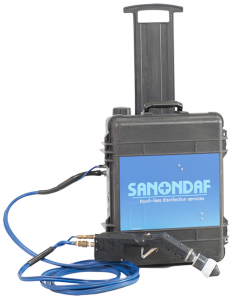
Because the cycle is short, a nurse can treat a pen while the next consult runs and hand the room back the same shift. One 8kg machine comfortably treats up to five rooms per hour, depending on size.
- Isolation pens back in service the same day, not the next
- Consult rooms reset between infectious patients rather than closed
- Transport crates and the animal ambulance treated in situ with no soaking or drying
- A dated certificate per treatment for the practice file
Where the money actually goes
A single attended call-out is from £495–£1,095 + VAT. A lease from £450 per month + VAT across roughly 60 treatments a month works out at around £10–£12 + VAT per treated room once chemical is counted, and the machine is there at 9am when the puppy arrives rather than on Thursday.
That price difference is why practices stop treating fogging as an outbreak measure and start scheduling it — pens between patients, consult rooms overnight, the prep area weekly.
Building it into the rota you already run
Nothing about this needs new headcount. Two nurses per site are trained as operators during the lease set-up, the machine is dropped into a cleaned room with a do-not-enter card showing the safe entry time, and the team moves on to the next room while it works.
Multi-site groups usually keep the unit at the busiest practice and move it by van, which is straightforward with a hand-portable 8kg machine.
Frequently asked
- Can practice staff operate the machine themselves?
- Yes. Only trained and competent staff may operate it, and on-site operator training is included in the lease. We can also train a nominated person to induct new starters.
- Is the disinfectant safe around animals and equipment?
- SanoChem is a hydrogen peroxide based disinfectant that breaks down to water and oxygen and leaves no corrosive residue on equipment or surfaces. Rooms are unoccupied during treatment and re-entry times are set per room at survey.
- Can we lease a machine as a small independent practice?
- Leasing is available to registered organisations approved for the application, for use on their own sites. Single-site independents are eligible; individuals are not.
Sources: material published by Sanondaf UK at sanondaf.co.uk (news, research and case studies) and the technical and commercial documentation held by the Shropshire & West Midlands office. Figures are indicative and confirmed at survey. Efficacy is stated as up to 99.9999% reduction.