
Method comparison
The problem with touchpoints: nobody touches the touchpoint
"Touchpoint cleaning" became the default vocabulary of infection control in 2020, and it has been repeated so often since that most people have stopped examining the words. It is a reasonable idea stretched a long way past what it can carry. The wording was never really right — and once you watch how people actually move through a building, the problem becomes obvious.
In short
Touchpoint cleaning assumes people touch a predictable set of named spots at a predictable height. They do not — they shove the glass, hip the door, lean on the wall, grab the frame. Whole-volume fogging treats the entire room without deciding in advance what mattered, so there is no list to get wrong and only one touchpoint left: the start button on the machine.
7 min read ·
You clean the handle. Nobody used the handle.
Stand and watch a busy corridor door for five minutes. Someone pushes it open flat-palmed on the panel, well above the handle. Someone else has a tray in both hands and shoulders it. Someone kicks the bottom rail. A cleaner nudges it with a trolley. Perhaps one person in ten actually grips the handle that appears on the cleaning schedule.
The same is true across the building. People push the glass of a window to swing it open rather than the catch. They lean on the wall beside the lift rather than press anything but the button. They grab the door frame to swing round a corner. They put a hand on the top of a chair back, on the edge of a desk, on the end of a bed rail. None of that is on the touchpoint list, and all of it is contact.
- Doors: the panel, the glass, the frame, the bottom rail — not the handle
- Windows: the pane, not the catch
- Corridors: the wall beside the door, the corner of a partition
- Furniture: chair backs, desk edges, bed rails, trolley handles nobody logged
Height is the part nobody plans for
A touchpoint list implicitly assumes one standard human. Real buildings do not contain one. A tall member of staff pushes a door high; a shorter colleague pushes the same door low. A child touches at knee and hip height on surfaces an adult never contacts. A wheelchair user's hands land on frames, arm rests and wall edges at a completely different band. A resident using a frame steadies themselves on whatever is nearest, which is usually a wall.
So even in the ideal case, where staff clean every named touchpoint perfectly, the cleaned zone is a narrow horizontal band chosen by whoever wrote the rota. The contamination is not confined to that band, because the people are not.
And then there is everything that was never a touchpoint
Touchpoint cleaning also treats contamination as though it only travels by hand. A great deal of it does not. Aerosols from a coughing patient, from a toilet flush, from a norovirus incident, from mould spores disturbed when a cupboard is opened — these move with the air and settle wherever the air takes them, which is the tops of cupboards, the light fittings, the curtain folds, the vertical faces of walls and the underside of shelving.
None of that is reachable, memorable or listed. It is also invisible, which is why touchpoint regimes feel like they are working right up until an outbreak says otherwise.
- Airborne spread settles far outside any hand-contact band
- High surfaces and undersides are almost never on a rota
- Soft furnishings and carpet hold contamination inside the fibre, not on top of it
- Nothing about a touchpoint round is measurable after the fact
Fogging has no prejudice about who touched what
A whole-volume fog does not make a judgement in advance about which surface mattered. It fills the room, follows the air currents and settles on all of it — the handle and the panel and the glass and the frame and the wall beside it and the top of the cupboard and the chair back at every height a human might use. Tall, short, seated, standing, staff, visitor, child: all treated the same, because the process never asked.
That is the honest advantage over a touchpoint round. Not that fogging is stronger chemistry, but that it removes the decision. There is no list to keep up to date, no assumption about behaviour to get wrong, and no dependence on how much time a member of staff had left at the end of a shift. The process is identical on every run.
The only touchpoint left is the start button
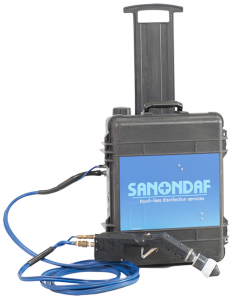
This is the line we use, and we mean it fairly literally. Set the machine, close the door, press start, put the sign up. One contact, by one trained member of your own staff, on your own leased machine. The cycle runs in minutes and the room comes back into service the same shift, with a dated record for the file.
It also fits the rota you already run rather than replacing it. Clean the room the way you always did — soil removal still matters and always will — then let the fog handle the coverage a cloth was never going to achieve. Nobody has to be re-trained into a new philosophy of cleaning; they gain a step at the end that finishes the job properly.
- Clean as normal to remove soil and organic load
- Close the room, run the cycle — up to five rooms per hour with one 8kg machine
- Re-entry times set per room at survey and shown on the door sign
- Certificate per treatment for inspections and the compliance file
What it costs to stop guessing
Leases start from £450 per month + VAT, first three months up front, terms up to 36 months, plus a chemical commitment from 100 litres. Across the rooms a site treats in a normal month that generally works out around £10–£12 + VAT per treated room, which is a different order of number from an attended call-out for a single room.
And unlike a touchpoint round, the result does not depend on how busy the corridor was that day.
Frequently asked
- Is touchpoint cleaning a waste of time then?
- No. Cleaning high-contact surfaces removes soil and reduces load, and it should carry on. The point is that a touchpoint list is a guess about human behaviour, and it cannot cover heights, habits or airborne spread. It is a floor, not a ceiling.
- How does fogging cover surfaces nobody thought of?
- It does not target surfaces at all. The mist fills the room volume and moves with the air, so it settles on everything in the space at once — including the air itself, high surfaces, undersides and the wall areas people actually push.
- Do staff need protective equipment to run a cycle?
- Training and the safe operating procedure are included with the lease, and re-entry times are set for each room at survey and displayed on the door sign. Your trained staff set the machine, leave the room and return when the sign says it is clear.
- Can we still evidence cleaning to an inspector?
- Better than before. Each treatment produces a dated record of the room treated, so the compliance file holds evidence of the whole-room process rather than a signature against a list of handles.
- Does it work on carpets and soft furnishings?
- Yes. Fine droplets settle into fibre and texture rather than sitting on top of it, which is where contamination hides after a normal clean, and the hydrogen peroxide based chemistry leaves no residue as it breaks down to water and oxygen.
Sources: material published by Sanondaf UK at sanondaf.co.uk (news, research and case studies) and the technical and commercial documentation held by the Shropshire & West Midlands office. Figures are indicative and confirmed at survey. Efficacy is stated as up to 99.9999% reduction.