
Research centres
A contamination event hits a suite tomorrow, with months of work next door
You find it on a Tuesday: a contamination event across a suite, with months of work sitting in the incubators next door. Everything now depends on how quickly the space can be decontaminated and, just as importantly, how well that decontamination can be evidenced before anyone works in it again.
In short
An on-site hydrogen peroxide capability lets you decontaminate a suite on your own schedule, with a logged cycle for the quality file — and without the handling, permits and timetable that formaldehyde brings.
7 min read ·
The timetable problem
Research schedules are not elastic. Grant milestones, culture cycles and instrument bookings all assume the space is available. Waiting for an external gassing team means the project waits too.
Formaldehyde-based approaches add their own timetable: handling controls, longer cycles, neutralisation and a set of paperwork nobody enjoys.
Why hydrogen peroxide suits research settings
Hydrogen peroxide breaks down to water and oxygen. There is no residue on instruments, no waste stream to dispose of and no neutralisation step, which is why it has become the default for sensitive environments.
SanoChem is tested to EN 14476, EN 1276, EN 1650 and related standards, with up to 99.9999% reduction achievable under validated conditions. Sanondaf's published work includes decontamination of a contained vessel inside a biotechnology facility without dismantling the equipment.
- Suites, cold rooms, animal facilities, prep rooms and equipment stores
- Shutdown and maintenance windows used for whole-suite preventative cycles
- Dated certificates and cycle records for the quality management file
- No residue on instruments, optics or electronics
Owning the capability changes what you treat
The reactive case is easy to argue. The bigger gain is preventative: treating suites during planned shutdowns, before a big run, after a visiting group, or between projects — at roughly £10–£12 + VAT per treated room rather than a call-out fee each time.
That is when contamination stops being an event you respond to and starts being a risk you manage.
Frequently asked
- Can this replace formaldehyde fumigation?
- For many room and suite applications, hydrogen peroxide based fogging is used in place of formaldehyde because it leaves no residue and requires no neutralisation. Suitability for your specific containment level is confirmed at survey.
- Will it damage sensitive instruments?
- There is no corrosive residue. Specific instrument handling is covered in the survey and in operator training.
- Do you support biosafety cabinet work?
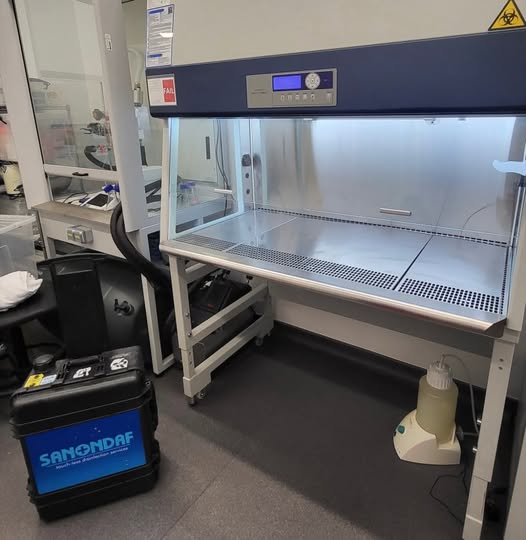
- Sanondaf publishes guidance and end-user seminars on safety cabinet decontamination, and our team can advise on how leased equipment fits alongside cabinet gassing requirements.
Sources: material published by Sanondaf UK at sanondaf.co.uk (news, research and case studies) and the technical and commercial documentation held by the Shropshire & West Midlands office. Figures are indicative and confirmed at survey. Efficacy is stated as up to 99.9999% reduction.