
Chemistry guide
Hydrogen peroxide or formaldehyde? Why our chemistry replaced the old fumigant
If your site has a decontamination procedure written more than a decade ago, there is a good chance it still names formaldehyde. Laboratories, mortuaries and containment facilities used it for years because it worked. The reason the industry moved on has less to do with efficacy and more to do with what the fumigant does to the people who have to work around it — and what it leaves behind. Here is the comparison, referenced to the published material in our technical file.
In short
Formaldehyde works, but it is classified by the International Agency for Research on Cancer as carcinogenic to humans, and traditional room fumigation with it has been abandoned on those grounds — France recommended against it for room decontamination from September 2006 and ended production in January 2007. Hydrogen peroxide gives comparable whole-room results and then breaks down to water and oxygen, leaving no residue and no waste stream: more than 5-log₁₀ reduction of M. tuberculosis across a BSL3 laboratory, a 6-log kill of Geobacillus spores from one 10-minute fog, and re-entry in around an hour rather than a long purge.
7 min read ·
Why did formaldehyde fumigation fall out of use?
Traditional room fumigation was conducted with formaldehyde or ethylene oxide gas, and both have largely been given up because of toxicity and carcinogenicity. In June 2004 the International Agency for Research on Cancer classified formaldehyde as carcinogenic to humans. France recommended from September 2006 that it not be used for room decontamination, and production was stopped definitively in January 2007.
That left laboratories and hospitals needing an alternative, and hydrogen peroxide became the practical answer: biologically effective across a wide range of organisms, and safe by design because it readily decomposes into water and oxygen. The published literature in our file describes dry mist hydrogen peroxide explicitly as a promising and effective alternative to the currently used formaldehyde.
- Formaldehyde: IARC-classified carcinogenic to humans (2004)
- Withdrawn from room decontamination use in France from 2006; production ended 2007
- Long purge and neutralisation before re-entry, with a residue to deal with
- Hydrogen peroxide breaks down to water and oxygen — no residue, no waste stream
Is hydrogen peroxide actually as effective?
On the organisms that decide whether a decontamination is credible, the data in our file is strong. Against Mycobacterium tuberculosis — highly resistant to decontamination and equipped with defences against oxidative stress — a 5% hydrogen peroxide dry mist run for 25 minutes in an 80m³ BSL3 laboratory reduced viable bacteria by more than 5 log₁₀ across three separate runs, with no colonies growing from any biological indicator, including those inside operational safety cabinets, inside closed incubators and 9.5 metres from the machine.
Against spores, sporicidal testing of fogged Sanosil S10 achieved a 6-log kill of Geobacillus stearothermophilus — the standard sterilisation bio-indicator strain — from a single 10-minute fog with 30 minutes of contact time.
Against viruses, a Journal of Hospital Infection study of hydrogen peroxide vapour found no viable virus recovered after exposure for structurally distinct viruses dried on stainless steel: human adenovirus, feline calicivirus (a norovirus surrogate), transmissible gastroenteritis coronavirus (a SARS-CoV surrogate) and avian and swine influenza — all showing greater than 4-log reduction at the lowest vaporised volume tested.
In hospital isolation rooms, a UCLH and Public Health England study of two hydrogen peroxide vapour systems recorded a 5.1 log₁₀ reduction in C. difficile spores and around 6.3 log₁₀ reduction of MRSA and Klebsiella pneumoniae in all areas of the test room, even in the presence of heavy soiling — and concluded the choice between systems could be made on cost and convenience rather than efficacy.
What is the difference in downtime and re-entry?
This is where the operational case is decided. Fumigation with formaldehyde means a long dwell, active removal or neutralisation, and a careful re-entry procedure with respiratory protection available for emergencies. With hydrogen peroxide, the by-products are water and oxygen, so aeration is a decomposition step rather than a disposal problem — in the Sanosil sporicidal testing the room was evacuated of hydrogen peroxide to minimum detectable levels within 60 minutes.
Short cycles are what make treatment a routine rather than a shutdown project. A room can be handed back the same visit, which is why leased machines end up used weekly instead of once a year.
What about materials, equipment and residue?
The low-concentration chemistry used in dry mist systems is a hydrogen peroxide solution with trace stabilisers and silver ions in osmosed water, and is not classified as carcinogenic by IARC. In the BSL3 study, no surface or material damage was noted after exposure in a laboratory full of cabinets, incubators, freezers and computing equipment.
Because there is no residue, there is nothing to wipe off afterwards and no waste stream to dispose of — which is what makes the same chemistry acceptable in food production, clinical areas, cabins, vehicles and homes as well as containment laboratories.
How do we evidence it for a risk assessment or an auditor?
Detailed responses are what risk assessments ask for, so cycles are run to a defined recipe and evidenced. Biological indicators can be used to validate a cycle in your own space, and a disinfection certificate can be issued per treated area — useful where a customer, inspector or client wants proof that a room, cabin or vehicle was treated on a given date.
With a leased machine on site, that record builds itself as your own trained staff run the rounds — daily, weekly, monthly, quarterly or annually — instead of depending on an external visit.
What does moving away from formaldehyde involve?
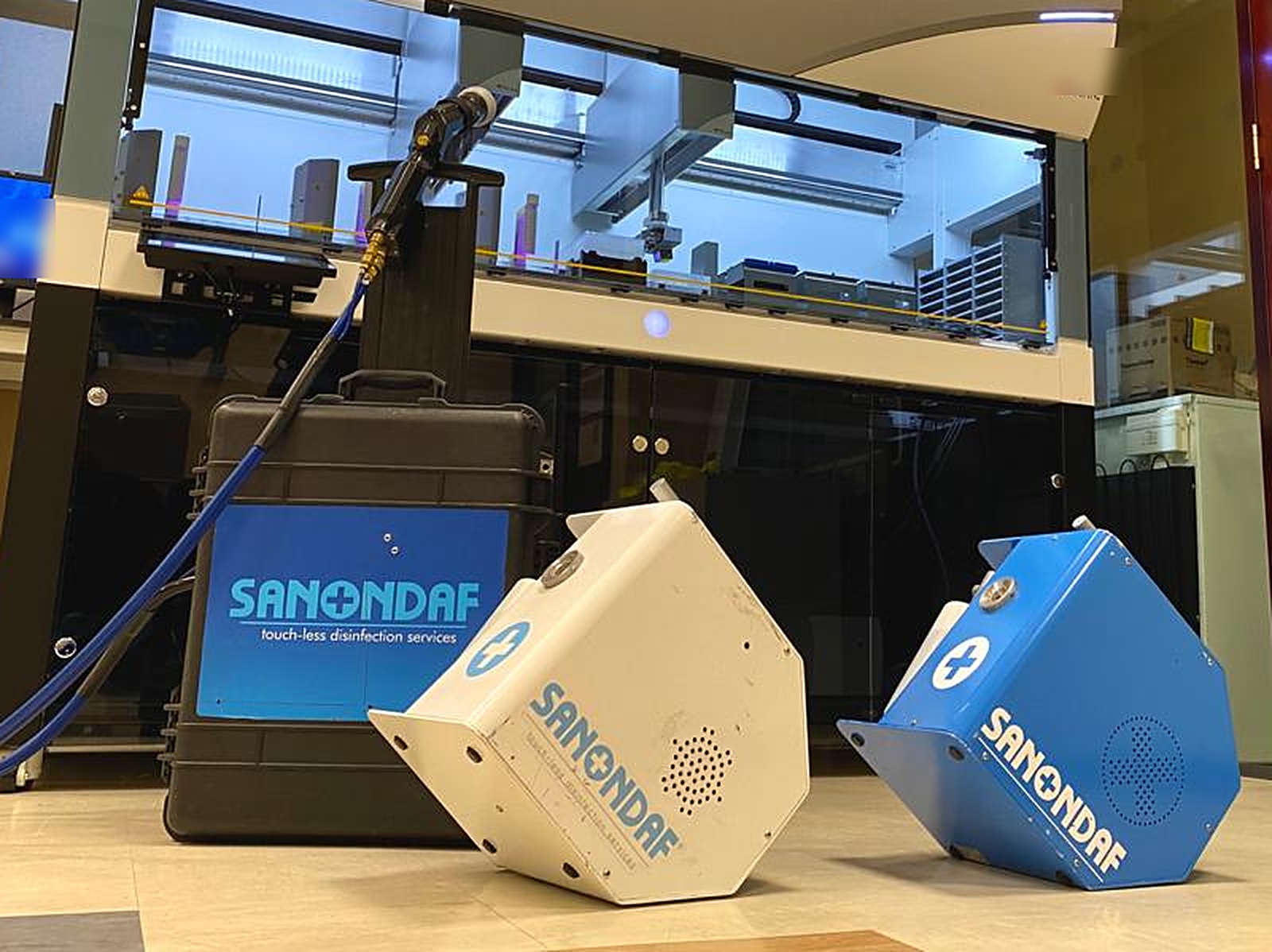
For most sites it means one machine, trained staff and a change to the cleaning schedule rather than a capital project. Machines are hand-portable at around 8kg and lease from £500 per month + VAT on a fixed term, with chemical from a 100L minimum, and one machine treats up to five rooms per hour depending on size.
Leasing is available to approved registered companies and institutions treating their own group sites with specifically trained staff — not to individuals. If a first changeover feels daunting, we can attend with a couple of machines at a reduced rate and supervise it with you.
Frequently asked
- Is formaldehyde banned?
- The material in our file records that IARC classified formaldehyde as carcinogenic to humans in 2004, that France recommended against its use for room decontamination from September 2006, and that its production was stopped definitively in January 2007. Traditional fumigation with formaldehyde and ethylene oxide has largely been given up on toxicity and carcinogenicity grounds. Check your own national and sector rules for current status.
- Will hydrogen peroxide handle spores and TB?
- The studies in our file show a 6-log kill of Geobacillus stearothermophilus spores from a single 10-minute fog, more than 5-log₁₀ reduction of M. tuberculosis throughout an 80m³ BSL3 laboratory, and 5.1 log₁₀ reduction of C. difficile spores in hospital isolation rooms even under heavy soiling.
- How long until the room can be used again?
- In sporicidal testing the room was down to minimum detectable hydrogen peroxide levels within 60 minutes of a 10-minute fog. Safe entry times are set per room at survey and shown on the door sign.
- Does it leave a residue?
- No. Hydrogen peroxide decomposes to water and oxygen, so there is no residue to remove and no waste stream to dispose of.
Sources: material published by Sanondaf UK at sanondaf.co.uk (news, research and case studies) and the technical and commercial documentation held by the Shropshire & West Midlands office. Figures are indicative and confirmed at survey. Efficacy is stated as up to 99.9999% reduction.