
Morgue & funeral
A notifiable infection arrives tomorrow, and families are booked in for viewings
The transfer is booked for tomorrow morning and the paperwork flags a notifiable infection. The preparation room, the fridge space and the vehicle all need to be handled properly. Families are arriving in the afternoon for viewings, and this is not a business where anybody wants to be explaining a delay.
In short
With a unit on the premises, the preparation room, fridge space and transfer vehicle are treated in short cycles between arrangements, discreetly, with a dated record — no third-party visit and no rescheduled families.
6 min read ·
Discretion is part of the specification
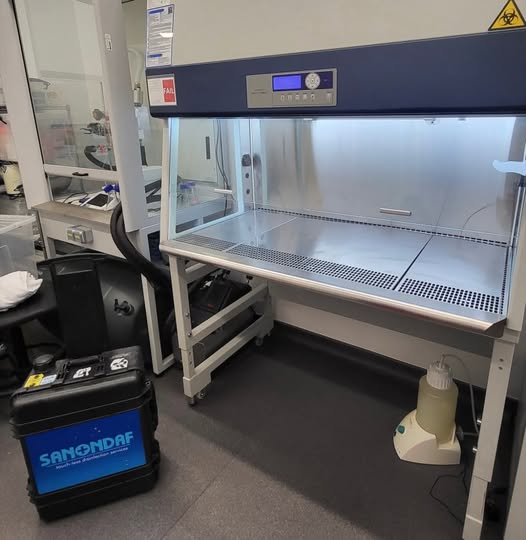
Most decontamination conversations are about speed and cost. In funeral care there is a third requirement that is just as firm: nothing about the process should be visible or audible to a family in the building.
An external team arriving with equipment during viewing hours fails that test regardless of how good the treatment is. An in-house cycle run by your own staff between arrangements does not.
What gets treated
Preparation rooms, chapels of rest, fridge and body store areas, transfer vehicles, and the office and reception spaces that families use. All of it fits on a single rota, and the machine is hand-portable at 8kg so moving it between the vehicle bay and the prep room is a one-person job.
The disinfectant is hydrogen peroxide based, leaves no residue on surfaces or fittings and breaks down to water and oxygen, so there is nothing to ventilate out beyond the calculated re-entry time.
- Preparation rooms treated between cases rather than at the end of a week
- Transfer vehicles treated in situ after every high-risk collection
- Chapels of rest and family rooms on a routine preventative cycle
- Dated certificates for the staff health and safety record
Protecting your own people first
The people most exposed here are your staff, repeatedly, across every case. The strongest argument for a machine on site is not the notifiable case tomorrow — it is the routine treatment of the prep room and vehicle that happens every week afterwards.
At roughly £10–£12 + VAT per treated space, that routine is affordable in a way per-visit pricing never is.
Frequently asked
- Can it be used in occupied buildings?
- The room being treated must be unoccupied and closed for the cycle and the calculated re-entry period. The rest of the premises continues as normal.
- Does it damage fittings, timber or fabrics?
- No. There is no corrosive residue; the disinfectant breaks down to water and oxygen.
- Can independents lease, or is this only for groups?
- Leasing is open to registered organisations approved for the application, including single-site independent funeral directors.
Sources: material published by Sanondaf UK at sanondaf.co.uk (news, research and case studies) and the technical and commercial documentation held by the Shropshire & West Midlands office. Figures are indicative and confirmed at survey. Efficacy is stated as up to 99.9999% reduction.