
Hire & leasing
Fogger machine leasing for outbreak response: what a five-minute start is worth
Outbreaks do not wait for a delivery slot. The organisations that manage them best are not the ones with the biggest budget — they are the ones who could start treating within minutes of the first case being reported.
In short
Calling for equipment after an outbreak starts means 6 to 24 hours of waiting before the first room is treated — longer at weekends and far longer at sea. A leased machine already on site with trained staff starts in about five minutes, which is normally worth more than the entire annual lease cost in avoided closures.
6 min read ·
What actually happens in the first 24 hours?
Report the case. Find the right manager. Get a purchase order raised. Call a supplier. Wait for availability. Wait for travel. Sign in. Find estates. Move equipment through a live building. In practice that is 6 to 24 hours before a fog cycle begins, and on a vessel away from port 24 to 120 hours.
Meanwhile the affected area keeps generating exposures. Every hour of that timeline has a cost in closures, cancelled admissions, cancelled lessons, lost covers or lost production.
How does an on-site machine change the sequence?
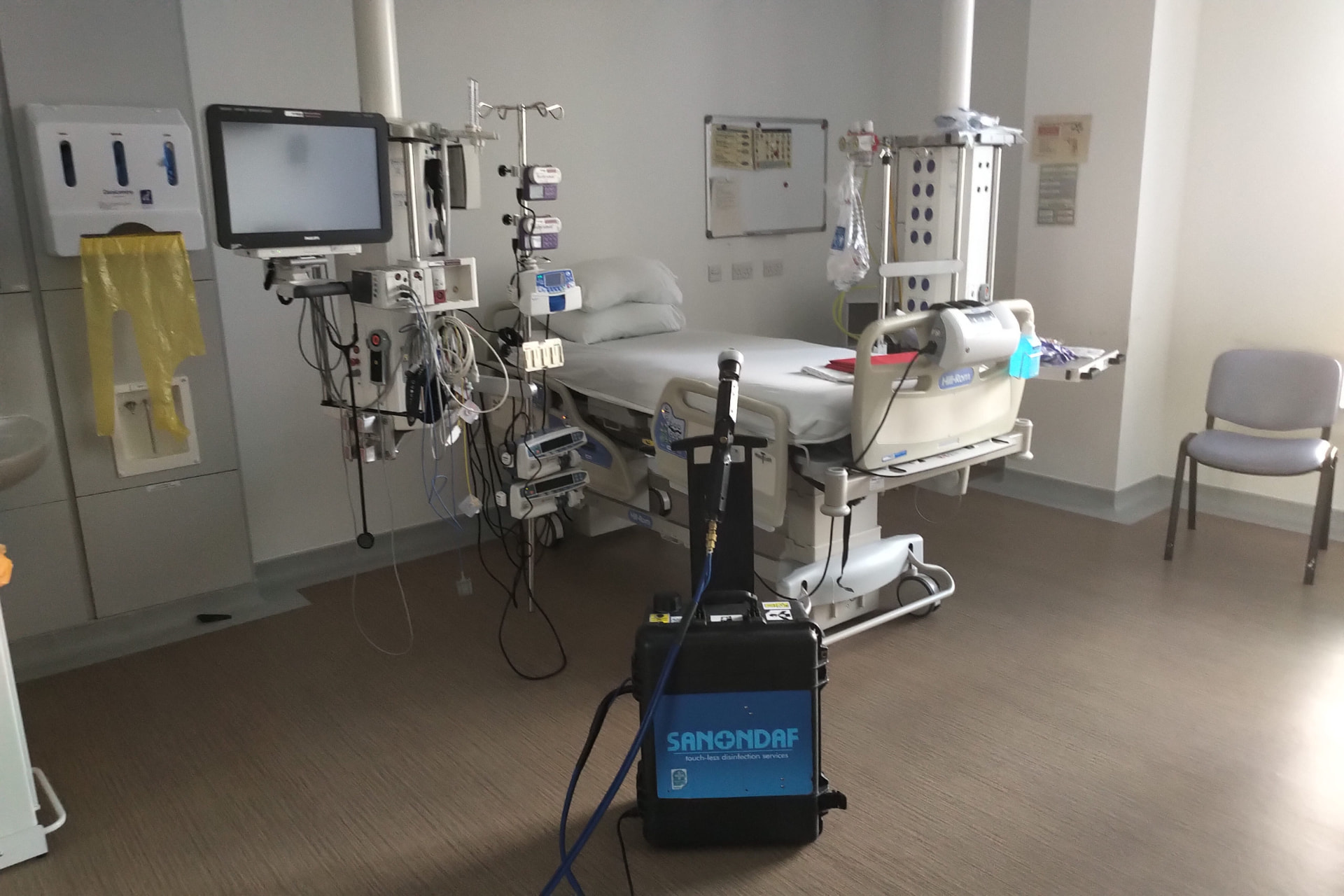
Trained staff you already employ take the machine to the affected room, run the cycle, hang the sign with the safe entry time and move on. First treatment starts in around five minutes and the room usually reopens within the same shift.
Because the marginal cost of one more treatment is essentially the chemical, containment stops being rationed. You treat the adjacent rooms, the corridor, the toilets and the staff room too.
What does it kill?
Our hydrogen peroxide based fog supports up to 99.9999% (6-log) reduction across bacteria, viruses, fungi and spores. The evidence file includes 6-log reduction of Geobacillus stearothermophilus spores from a single ten-minute fog and more than 5-log reduction of Mycobacterium tuberculosis across an 80m³ laboratory.
Norovirus, C. difficile, MRSA and influenza-type organisms are the ones we are usually asked about in outbreak planning, and whole-volume fogging is designed exactly for that class of problem.
Does it replace our cleaning team?
No — it plugs into them. Fogging follows the standard clean; it does not replace it. Your own janitors, housekeepers or cleaning staff build it into the daily, weekly, monthly or quarterly round.
Done efficiently the machine leapfrogs down a corridor behind the cleaning trolley, adding only a few seconds per room to the round while delivering a full whole-volume decontamination.
Frequently asked
- How fast can a room be reopened after fogging?
- Cycles run in minutes and safe re-entry times are set per room volume at survey. In sporicidal testing, hydrogen peroxide was down to minimum detectable levels within 60 minutes of a ten-minute fog.
- Can we get help with the first outbreak while our staff train?
- Yes. We can attend with a couple of machines at a reduced rate to run or supervise the response while your team gets confident — a hybrid between an attended service and a lease.
- Is fogging safe around patients and residents?
- Rooms are fogged empty and closed, with a door sign showing the safe entry time. That is a standard part of the operator training included with the lease.
- How much does an attended visit cost instead?
- From £495–£1,095 + VAT per attended visit, every time. That is the figure most organisations end up comparing against a fixed monthly lease.
Sources: material published by Sanondaf UK at sanondaf.co.uk (news, research and case studies) and the technical and commercial documentation held by the Shropshire & West Midlands office. Figures are indicative and confirmed at survey. Efficacy is stated as up to 99.9999% reduction.