
Equipment guide
Electrostatic sprayer hire: where the 75x attraction actually earns its keep
Electrostatic spraying is genuinely clever technology, and it is also frequently mis-sold as a replacement for whole-room disinfection. Here is where it wins, where it does not, and how sites use both without duplicating cost.
In short
Electrostatically charged droplets are attracted to surfaces around 75 times more strongly than gravity, so they wrap around objects and coat the sides and undersides a spray never reaches. That makes electrostatic ideal for high-touch detail — chairs, rails, trolleys, vehicle interiors — while fogging remains the method for whole rooms.
6 min read ·
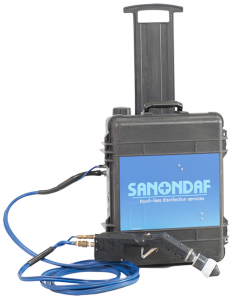
What does the charge actually do?
Each droplet leaves the nozzle carrying an electrical charge. Charged droplets are drawn to earthed surfaces with an attraction around 75 times greater than gravity alone, so instead of falling past an object they curve towards it and wrap around it.
The practical result is coverage on the back and underside of a chair leg, a handrail or a keyboard from a single pass at the front.
Where electrostatic beats fogging
Complex, cluttered, high-touch objects in spaces that stay occupied. Gym equipment, waiting-room seating, reception desks, retail fixtures, bus and train interiors, trolleys and equipment banks.
It is also useful where a room cannot be closed for a full fog cycle, because the operator works surface by surface rather than treating the whole volume.
Where fogging still wins
Whole rooms, hidden surfaces, ceiling voids in airflow and anywhere the requirement is total volume coverage rather than targeted surfaces. Outbreak response, laboratory decontamination, mould-affected voids and full room turnover all sit here.
Fogging is also far faster per room, which is why it is the method that scales to five rooms an hour.
How do sites combine the two?
Fogger as the backbone on the cleaning round, electrostatic as the daily detail tool in high-traffic areas. Most sites start with the fogger and add electrostatic where they discover high-touch surfaces dominate.
Both can sit on the same lease arrangement with the same chemical supply and the same trained operators, which keeps the paperwork and the training in one place.
Frequently asked
- Is electrostatic spraying better than fogging?
- Neither is better; they answer different questions. Electrostatic is for high-touch detail and awkward shapes, fogging is for whole-room volume coverage.
- Can we hire just an electrostatic sprayer?
- We lease to approved organisations and will advise honestly on the mix. In most buildings the fogger delivers more per pound, with electrostatic added where detail work dominates.
- Does electrostatic spraying leave surfaces wet?
- It applies a fine even layer rather than soaking a surface, which is part of why it suits occupied areas and quick turnaround.
- Does it use the same disinfectant?
- Yes — the same hydrogen peroxide based chemistry supplied on the same account and covered by the same training and documentation.
Sources: material published by Sanondaf UK at sanondaf.co.uk (news, research and case studies) and the technical and commercial documentation held by the Shropshire & West Midlands office. Figures are indicative and confirmed at survey. Efficacy is stated as up to 99.9999% reduction.