
Technology guide
Dry fogging vs wet fogging: why our machines run dry
Fogging is a tried and tested method for whole-room decontamination, and it is the part of the process that does what cleaning cannot: it treats the air and every surface in the volume at once. Not every fogger behaves the same way. The key difference is droplet size: fine enough and the mist stays airborne, dries without wetting and fills the whole volume; too coarse and it settles as moisture, raising humidity and leaving surfaces damp. This guide explains why our machines are set up to fog dry.
In short
Dry fogging produces droplets fine enough to stay suspended and behave almost like a gas, filling the whole room volume and drying without wetting surfaces. Wetter fogging systems use larger droplets that settle faster and can leave moisture behind, raising humidity and extending drying time. Our Sanondaf machines are set up to fog dry: independent testing of fogged Sanosil hydrogen peroxide disinfectant achieved a 6-log kill of Geobacillus stearothermophilus spores in a single 10-minute fog with 30 minutes' contact, with the room down to minimum detectable peroxide levels within 60 minutes.
7 min read ·
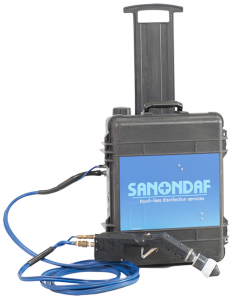
What is dry fogging?
Dry fogging atomises a low-concentration hydrogen peroxide based disinfectant into droplets fine enough to remain airborne and diffuse through the volume, behaving much more like a gas than a spray. Surfaces are not left wet, there is no pooling, and nothing needs drying or rinsing afterwards.
That gas-like behaviour is what gets treatment into the places a cloth never sees. In published work included in our technical file, a 5% hydrogen peroxide dry mist was diffused into an 80m³ biosafety level 3 laboratory: viable Mycobacterium tuberculosis was reduced by more than 5 log₁₀ with no growth from any biological indicator — including indicators inside operational safety cabinets, inside closed incubators, on the ceiling, and 9.5 metres away from the machine. No surface or material damage was noted afterwards.
- Droplets stay suspended and fill the room volume
- Surfaces are treated without being wetted — no rinsing, no drying time
- Reaches shadowed and enclosed spaces, including cabinets and closed incubators
- Ideal for laboratories, clean rooms, safety cabinets, wards, cabins and offices
Why wetter fogging can cause problems
Some fogging systems throw larger droplets that fall faster and land wetter. The room may look treated, but the extra moisture raises humidity, extends drying time and can leave residue on floors, equipment and soft furnishings. In sensitive environments — wards, labs, offices with IT, food production, vehicle interiors and cabins — that dampness is exactly what you do not want.
Wetter fogging also tends to need more downtime. Staff must wait for surfaces to dry, sensitive items may need covering, and the evidence trail for a validated dose is harder to maintain. Dry fogging avoids those issues because the chemistry is delivered as a fine mist that behaves like the air in the room.
- Larger droplets settle faster and can leave surfaces damp
- Raised humidity and longer drying times slow handback
- Sensitive equipment and soft furnishings may need extra protection
- Dry fogging keeps downtime short and residue minimal
How long does a cycle take, and when can staff go back in?
Cycles are short, which is what makes preventative rounds realistic. In sporicidal testing of fogged Sanosil S10 disinfectant, a 6-log kill of Geobacillus stearothermophilus spores — a standard sterilisation bio-indicator strain — was achieved with a single 10-minute fog and 30 minutes of contact time, and the room was evacuated of hydrogen peroxide to minimum detectable levels within 60 minutes.
In day-to-day use, staff finish the standard clean, drop the machine in, put a small do-not-enter sign on the door with a safe entry time, and move on to the next room. The machine leapfrogs behind them. Done efficiently, it adds only a few additional seconds of staff time per room.
Why is fogging better than spraying and wiping?
Manual disinfection is line-of-sight and depends on the operator selecting, applying and leaving the right chemical in contact for long enough on every single item. Research cited in Sanondaf's laboratory presentation found 49% of high-risk objects and surfaces in patient isolation rooms across 23 acute care hospitals were not cleaned at all, with light switches, door handles and toilet handles among the most commonly missed.
Whole-volume fogging removes that variable. Real-world programmes bear it out: at Nottingham University Hospitals, environmental sampling before and after hydrogen peroxide decontamination of high-risk rooms fell from 24% of samples positive for C. difficile to 3%, and mean colony counts from 6.8 to 0.4 per 10 samples. A 30-month prospective study cited in the same material found patients admitted to rooms decontaminated with hydrogen peroxide vapour were 64% less likely to acquire any multidrug-resistant organism.
Efficacy is stated as up to 99.9999% (6-log) reduction of bacteria, viruses, fungi and spores.
Which should we lease?
Most sites are best served by both: a fogger for whole-room work and an electrostatic machine for high-touch detail. Machines are hand-portable at around 8kg, lease from £500 per month + VAT on a fixed term with chemical from a 100L minimum, and one machine comfortably treats up to five rooms per hour depending on size.
Tell us the room sizes, ceiling heights and how quickly spaces must go back into use, and we will specify the combination — and if a particular outbreak or event feels beyond the routine, we can attend with a couple of machines at a reduced rate to supervise it.
Frequently asked
- Does dry fogging leave surfaces wet?
- No. The droplet size is fine enough that the fog behaves like a gas and dries without wetting surfaces, so there is no pooling, rinsing or drying time.
- Is fogging validated, or is it just a mist?
- It is validated with biological indicators. Fogged Sanosil S10 achieved a 6-log kill of Geobacillus stearothermophilus spores in one 10-minute fog with 30 minutes' contact, and dry mist hydrogen peroxide achieved more than a 5-log₁₀ reduction of M. tuberculosis throughout an 80m³ BSL3 laboratory.
- Can we fog rooms full of equipment and electronics?
- That is a common use. In the BSL3 study in our file, no surface or material damage was observed after dry mist exposure in a laboratory containing safety cabinets, incubators, freezers and computing equipment. We confirm any sensitive items at survey.
- How many rooms can one machine cover in a day?
- Up to five rooms per hour depending on their size. A modest routine of two rooms a day is around 60 rooms a month from a single leased machine.
Sources: material published by Sanondaf UK at sanondaf.co.uk (news, research and case studies) and the technical and commercial documentation held by the Shropshire & West Midlands office. Figures are indicative and confirmed at survey. Efficacy is stated as up to 99.9999% reduction.