
Emergency services
A confirmed infectious patient at the end of shift: does the vehicle run tomorrow?
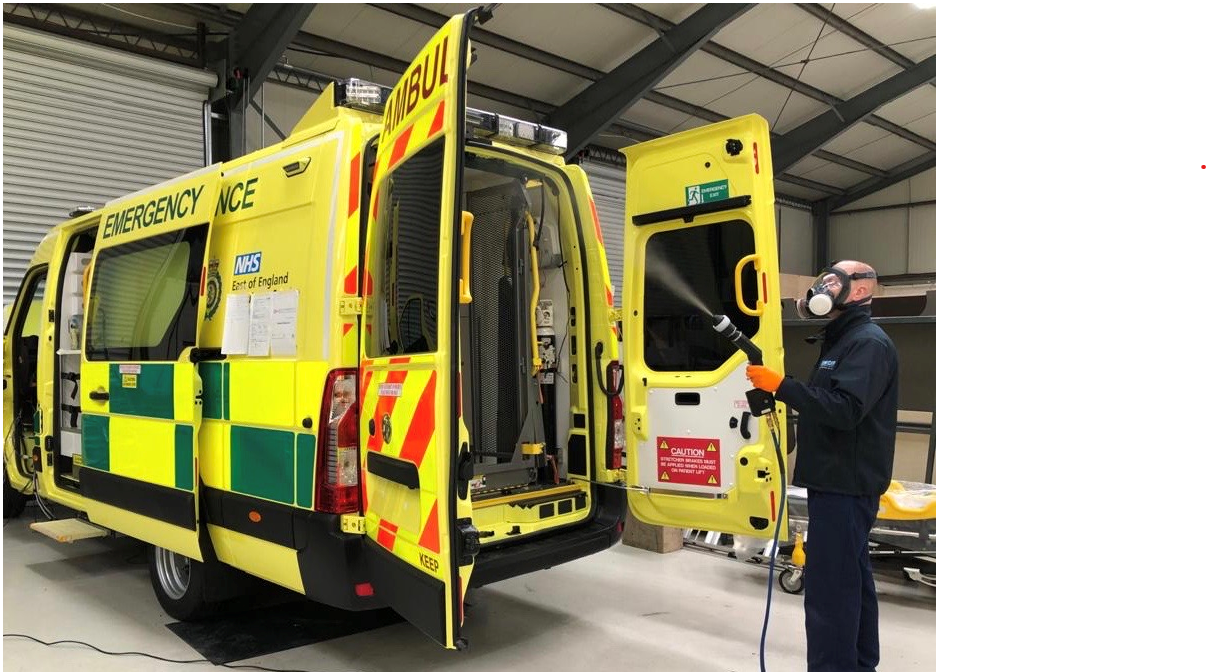
The last job of the shift turns out to be a confirmed infectious transfer. The vehicle is needed at handover. There is no dedicated decontamination bay at the station, and the alternative to sorting it now is standing the vehicle down and waiting for somebody else to arrive with a machine.
In short
Keep a leased unit at the station. The crew treats the saloon in a short cycle at the end of shift, the vehicle is available for the next shift, and the treatment is logged for the infection control record.
6 min read ·
Availability is the whole argument
For emergency services the cost of a treatment is almost irrelevant next to the cost of a vehicle out of service. A vehicle stood down is capacity removed from a rota that had none spare.
External response is measured in hours, not minutes — realistically 6 to 24 hours from reporting to a team on site. A machine at the station is measured in about five minutes.
What a saloon treatment actually reaches
Ambulance interiors are dense with equipment, straps, rails, seat mechanisms and cabinetry. Whole-volume fogging treats the space, so it reaches the stretcher frame underside, the cupboard interiors left open and the cab, rather than only the panels a cloth was run over.
The disinfectant is hydrogen peroxide based, leaves no corrosive residue on monitors, radios or defibrillators, and breaks down to water and oxygen.
- Treatment started within minutes of the vehicle returning
- The vehicle available for the next shift rather than stood down
- Station welfare areas, rest rooms and stores on the same rota
- A dated certificate per treatment for the infection control file
Same technology, familiar settings
This is the same Sanondaf technology leased and used by our hybrid service teams in settings including NHS England and Scotland, county councils and some of the UK's largest companies and institutions. SanoChem is tested to EN 14476, EN 1276 and EN 1650, with up to 99.9999% reduction achievable under validated conditions.
Frequently asked
- Can a crew treat a vehicle without a decontamination bay?
- Yes. The vehicle is treated closed, in a suitable parking position, with the door card showing the safe entry time. No bay or plumbed installation is needed.
- How long is the vehicle out of use?
- Re-entry time is calculated at survey against the vehicle volume. In practice treatments fit at the end of a shift, well inside the handover gap.
- Can we also treat the station itself?
- Yes. Rest rooms, welfare areas, stores and locker rooms are usually added to the same rota, which is where much of the value of an on-site machine comes from.
Sources: material published by Sanondaf UK at sanondaf.co.uk (news, research and case studies) and the technical and commercial documentation held by the Shropshire & West Midlands office. Figures are indicative and confirmed at survey. Efficacy is stated as up to 99.9999% reduction.